EDIT 2025/08/04: Information in this post has been corrected here. Article below is still valid, but doesn’t account for the Effusion (process in which a gas escapes from a container through a hole of diameter considerably smaller than the mean free path of the molecules).
I am frequently being asked a question why I prefer Hydrogen above Helium – and I am always using their atom sizes as one of the main arguments for Hydrogen (being bigger -> less leaky) being more economic. Well, it came to me that I never actually checked what sizes they are!
As always, my big friend Wikipedia, instantly provided me with answers I needed…. and more. So many citations below come from there. I am trying to quote where not it is exact citation, but basically whole article is a more or less a compilation of texts from there. So thank you Wikipedia!
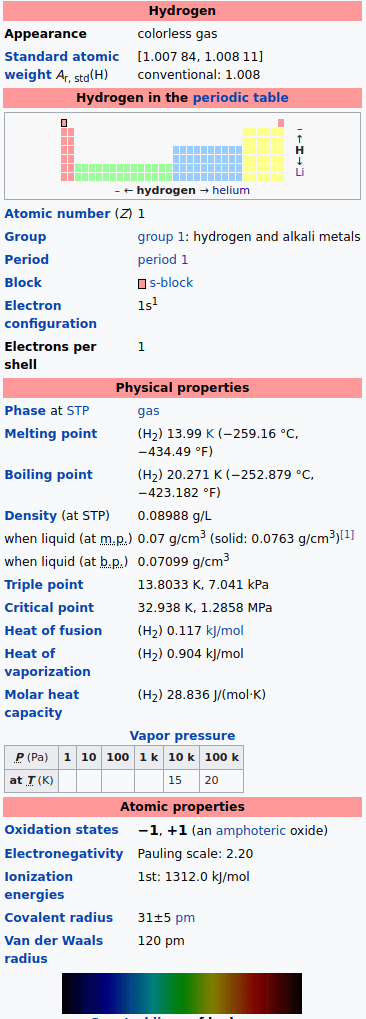
Let’s start with Hydrogen – Hydrogen is the chemical element with the symbol H and atomic number 1. Hydrogen is also the lightest element. At standard conditions hydrogen is a gas of diatomic molecules having the formula H2 (very important here). It is colorless, odorless, non-toxic, and highly combustible.
Our second competitor here is Helium – Helium is a chemical element with the symbol He and atomic number 2.
Helium’s natural occurrence is stated as Primordial nuclide – which are nuclides found on Earth that have existed in their current form since before Earth was formed and while while being the smallest and the lightest noble gas it is also one of the most unreactive elements we know so far (nonrenewable). It actually was commonly considered for a long time that helium compounds cannot exist at all, or at least not under normal conditions.

Unfortunately the value we need the most, cannot be found there, so I needed to keep searching for their Kinetic Diameter.
Kinetic diameter is a measure applied to atoms and molecules that expresses the likelihood that a molecule in a gas will collide with another molecule.
Wikipedia
Reading through that article you can see that Hydrogen (H2 molecule) comes with its kinetic diameter of 289pm (picometre), while Helium has “just” 260pm. Hydrogen molecule is 11% bigger than Helium. What this means for us? A lot! This actually explains why US airships (filled with Helium) were not flying to Europe and German Zeppelins (Hydrogen2) did many trans-Atlantic trips.
Problem was that Helium was leaking so fast through the Zeppelin’s envelope that they couldn’t carry enough of its canisters to refill it. Having Hydrogen being 6% lighter is just a nice bonus on top of it. 😉

Addendum (2024/02/28): The Impact of Temperature on Gas Permeability
Recent inquiries have highlighted an important aspect of gas behavior relevant to airship technology—the effect of temperature on the permeability of gases like helium and hydrogen through containment materials. As temperature increases, the kinetic energy of gas molecules also rises, leading to more frequent and forceful collisions with the fabric of the containment material. This heightened activity can increase the likelihood of gas molecules escaping through microscopic imperfections in the material, thus elevating the permeability.

This phenomenon underscores the importance of selecting materials that not only account for the inherent properties of the gases, such as atom size discussed in this article, but also their interaction with temperature variations. Understanding and mitigating these effects are crucial for enhancing the efficiency and longevity of airship envelopes, ensuring that they remain less permeable and more resilient under a range of operational temperatures.

 H2Use
H2Use 
One thought on “Helium vs. Hydrogen atom size”