Technical point of contact:
- Name: Jan Bilek
- Organization: HyUse PTY LTD
- Website: https://bbblimp.wordpress.com/
- Email: jan.bilek@h2use.com
- Phone: +61 498 103 179
Classification level: Unclassified
Technical Description
Executive Summary & Introduction
The HyUse platform proposes a scalable, hybrid airship-based Unmanned Aircraft System (UAS)capable of transporting 70,000 lbs of cargo efficiently and autonomously. Utilizing hydrogen for lift and fuel, it promises significantly reduced operational costs, flexible mission profiles, and sustainable logistics support.
The platform’s low-cost production target (<$15M per unit), reliance on COTS components, and proven prototype groundwork position it as a novel solution for DARPA’s cargo transport challenges. Detailed mission alignment and technical metrics are presented herein.
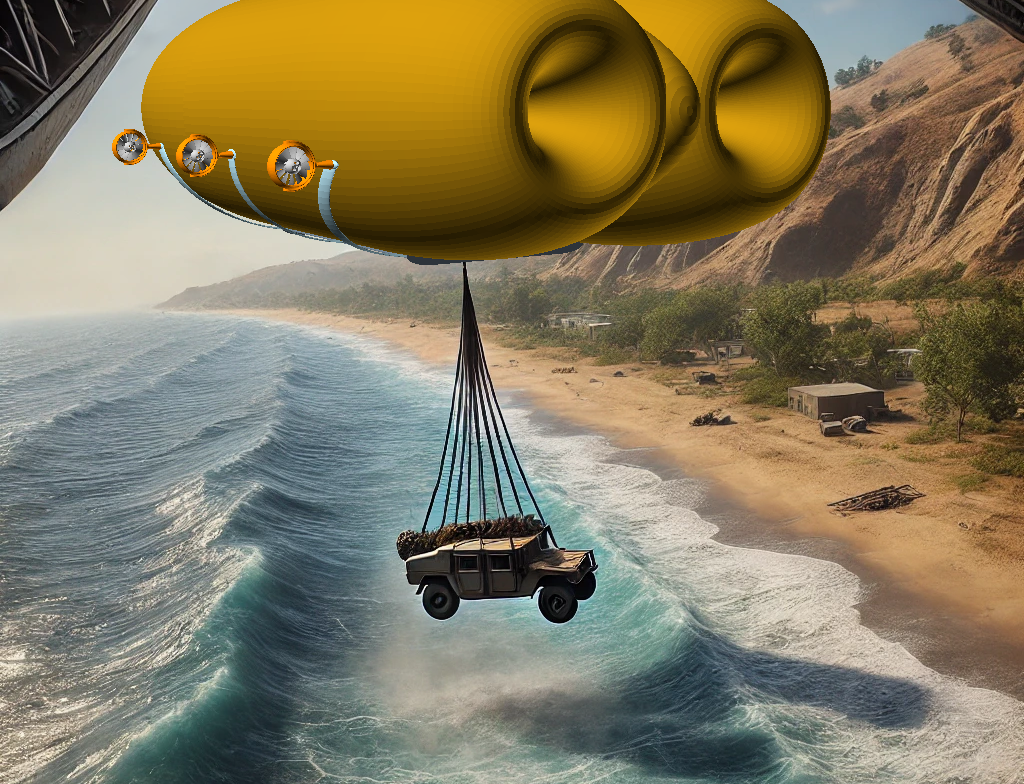
The HyUse platform introduces a hydrogen-powered hybrid airship concept designed to meet emerging heavy-lift UAS demands in challenging military logistics environments. By a novel dual-hull (bi-convex) configuration, it provides a paradigm shift away from traditional helicopters and tilt-rotor platforms.
Alignment with RFI Notional Mission Profile and Key Metrics
Notional Mission Profile:
- Mission Requirements (RFI):
- Depart from a prepared base and fly to the payload location.
- Attach and lift a 70,000 lb payload.
- Traverse 25 miles at approximately 500 ft above ground level (AGL).
- Detach the payload.
- Return to base (25 miles back).
Proposed Hybrid Airship Capability for the Above Profile:
| Payload Capacity | 70,000 lbs | Internal suspension below dual hull | ~5–10% lift margin |
| Gross Weight (Fully Loaded) | ~146,000 lbs | Includes airframe, fuel, and payload | Design Center of Gravity (CG) within ±2% |
| Envelope Volume | 3,200,000 ft³ | Hydrogen-filled for buoyant lift | Adjustable ballonets |
| Hover Power (Station-Keeping) | ~600 HP equivalent | Primarily offset by buoyancy | >20% excess power |
| Cruise Speed | ~87 mph (140 km/h) | At 500 ft AGL, calm conditions | Speed adjustable ±15% |
| Cruise Power | ~1,000 HP total | Electric motors powered by H2 fuel cells | ~20% thrust reserve |
| Drag (Cruise) | ~2,000–2,500 lbs (est.) | Parasitic + form drag from dual hull | Within thrust margin |
| Lift-to-Drag Ratio | ~4:1 (Buoyant + Aerostatic) | High buoyancy reduces required thrust | Allows low power cruise |
| Service Ceiling | ~9,840 ft (3,000 m) | Reduced payload above 5,000 ft | Sufficient for low-level ops |
| Range | >6,000 mi with H2 reserves | Extended by minimal hover power | Significant energy reserves |
| Endurance | Multi-day | Dependent on H2 supply & solar recharge | Flexible mission duration |
| Stability & Control | Positive dynamic stability | Gimbaled thrust, symmetric hull design | Control authority >15% over expected loads |
| Structural Integrity | Stress/strain <70% of limit | Carbon fiber (CF) & tensile members | Fatigue life: >3,000 hrs |
| Vibration & Aeroelasticity | Minimal at low speed | No high-frequency rotor vibrations | Reduced maintenance |
(Table 1: Key Performance and Design Parameters)
Hybrid Airship General Characteristics
The HyUse airship’s dual-hull (bi-convex) design and CF duct backbone, both fabricated from widely used commercial aerospace-grade materials, ensure stability, durability, and controllability. Its modular structure, assembled from commercially available standard fittings and subassemblies, simplifies maintenance and allows for rapid configuration changes. The propulsion system – comprising off-the-shelf electric motors, hydrogen fuel cells, and standard power electronics – is sized and selected to meet the lift and thrust margins described in the “Alignment with RFI Requirements” section.
- Crew: Unmanned (optional configuration for 2–4 human operators)
- Capacity: Up to 70,000 lbs (31,750 kg) payload or ~290,000 ft³ (8,000 m³) cargo volume (cargo bay: 65 ft × 65 ft × 65 ft)
- Envelope:
- Volume: 3,200,000 ft³ (90,000 m³)
- Material: Thermoplastic polyurethane-based laminated fabric with integrated environmental protection coatings, sourced from established industry suppliers (e.g. permali.co.uk)
- Length: 200 ft (60 m)
- Width: 160 ft (50 m)
- Height: 130 ft (40 m)
- Weights:
- Empty weight: 80,000 lbs (36,287 kg)
- Max takeoff weight: 146,000 lbs (63,143 kg)
- Powerplant:
- 2 × AM AMR Dual Stack 250-90 AC Motor (Liquid Cooled, Permanent Magnet)
- Readily available from established electric propulsion suppliers
- Motor Diameter: 10.5″ | Case Length: 11.25″ | Weight: 180 lbs
- Rated ~420 HP Peak at 360 V, Max RPM: 10,000
- 6 x NetGain HyPer9 HV AC Motor X144 Controller Kit)
- Widely used in commercial electric vehicle conversions
- Motor Diameter: 9.0″ | Case Length: 13.75″ | Weight: 120 lbs
- Rated ~120 HP, Max RPM: 8,000
- 2 × AM AMR Dual Stack 250-90 AC Motor (Liquid Cooled, Permanent Magnet)
- Performance:
- Cruise Speed: ~87 mph (140 km/h)
- Range: Up to ~6,215 mi (10,000 km) under typical mission conditions
- Endurance: Multi-day; partial recharge possible (e.g., solar-assisted)
- Service Ceiling: 3,000 m (9,840 ft)
All critical components—motors, controllers, fuel cells, structural materials—are selected from established commercial suppliers with proven track records, ensuring a robust supply chain and simplifying logistics for both acquisition and sustainment.
Scalability
HyUse platform’s modular cargo bay makes the hybrid airship ideal for transporting equipment that is traditionally challenging to accommodate in conventional aircraft due to size or shape.
The primary limitation to scalability is the aerodynamic drag stress exerted on the envelope along its length, which can be mitigated by utilizing advanced materials or structural reinforcements. This ensures that the design meets DARPA’s requirements for various payload capacities (10,000 lb, 30,000 lb, 45,000 lb, 70,000 lb), offering a versatile platform adaptable to different mission profiles.
In terms of mission flexibility, the airship is well-suited for amphibious operations, wide-gap crossings, and general logistical support. The significant cargo volume enhances its ability to transport not only heavy loads but also oversized or irregularly shaped cargo that would be otherwise difficult to handle. The ability to adapt for different payloads and ranges provides a distinct operational advantage.
In addition, the platform’s modular avionics bay allows for integration of Electronic Countermeasures-hardened COTS components as mission requirements dictate, ensuring robust performance in contested electromagnetic environments. This adaptability supports rapid reconfiguration to maintain operational effectiveness and control authority under varying electronic warfare conditions.
Transportability
A key differentiator of the HyUse platform is its self-deployment capability. Unlike heavy-lift helicopters like the Sikorsky CH-53K, which require C-17 transport for relocation to remote or forward-operational areas, the HyUse airship can autonomously fly to mission areas, even to locations that are difficult to reach. With a cruising speed averaging 87 mph, the airship can reach any location on Earth within 7 days, reducing operational complexity and the reliance on additional logistical support.
Comparatively, the Sikorsky CH-53K King Stallion, with its 99 ft (30 m) length and external load hook capacity of 36,000 lbs, is limited by its dependency on external transport for extended deployment. HyUse airship’s ability to self-deploy without needing a separate transport aircraft significantly enhances operational flexibility.
Advanced Operational Scenario
Beyond the notional mission profile, HyUse airships can self-deploy intercontinentally. For instance, a swarm can cover ~6,215 mi (~10,000 km) in ~71 hours at 87 mph, using autonomous navigation (including non-GPS celestial methods), silence-capable comms, and optimized atmospheric routing. The swarm, primarily unmanned, may include optional human-crewed variants with reduced payload capacity. Upon reaching a staging area, the airships recharge partially via solar and remain positioned to respond rapidly (e.g., 1 hour per 87 mi leg).
At the operation zone, each airship uses a navigable gantry to transfer containerized payloads without landing, employing precise buoyancy management via ballonets, hydrogen adjustments, and gimbaled stabilization. Payloads can be swapped to deliver cargo, fuel, or specialized modules without traditional ground contact. In emergencies (e.g., fire), the system can jettison its envelopes and employ controlled descent or flotation devices. This approach minimizes risk, operational complexity, and infrastructure requirements while supporting extended, flexible mission profiles.
Naval Operations and Launch Considerations
Unlike other UAS, the HyUse avoids the need for naval assembly or launching, sidestepping the challenges associated with sea state conditions, wind, and the harsh saline environment. Traditional aircraft require costly and logistically complex ship-based deployment, whereas the HyUse’s ability to self-deploy and operate autonomously from any location greatly simplifies mission planning.
The navigable gantry system used for payload handling allows the airship to operate efficiently without conventional landing or takeoff. This reduces operational dependencies on suitable landing zones and improves adaptability in various operational environments.
Harsh Environment Adaptability
HyUse is also well-equipped for desert operations, where sand, dust, and temperature extremes pose significant challenges to traditional rotary-wing or fixed-wing platforms. By avoiding turbine and rotor systems being in a distance from ground (100 ft+), the hydrogen hybrid airship minimizes its vulnerability to dust ingestion and heat-related performance issues.
Cold and Arctic environments provide a natural lift benefit, whereas operations in high-temperature areas can be adapted by moderating payload capacity or optimizing the operational schedule, such as flying during cooler night-time conditions.
Battlefield Considerations and Survivability
Historically, airships have shown notable resilience to ballistic damage. The HyUse design leverages this advantage with a segmented gasbag layout and spare cells that minimize the impact of punctures from small arms, drones, or light anti-air threats such as RPGs. Such penetrations typically create only localized leaks that do not critically diminish overall lift. The hydrogen inside, while flammable in the presence of oxygen, is managed within a controlled, non-flammable envelope system, significantly reducing the risk of ignition or explosion.
Furthermore, a jettisonable gondola equipped with primary steering units allows for an emergency descent if severe structural damage occurs. The HyUse’s substantial payload capacity also supports modular defensive countermeasures—such as decoys, jammers, or lightweight directed-energy systems—to enhance survivability. These features collectively ensure that even under hostile conditions, damage to the airship remains manageable, preserving both mission effectiveness and crew safety (if crewed).
Maintainability and Cost Efficiency
Building on the technical foundations described earlier, the HyUse concept is designed for minimal maintenance through modular construction and reliance on readily available commercial parts. The cost structure, detailed in the Alignment section and throughout this document, ensures a sub-$15M unit cost while meeting DARPA’s heavy-lift needs.
This minimal-maintenance philosophy—supported by ultra-low-cost production techniques—enables rapid, cost-effective mass production. Consequently, multiple HyUse units can be fielded with overlapping mission profiles, creating a robust, distributed logistics support network. Modularity in critical components (e.g., gondolas, gasbags) allows quick replacement or repair, minimizing downtime and restoring operational capability promptly.
The HyUse relies solely on hydrogen for lift and fuel, reducing fossil fuel dependency and promoting sustainability. This hydrogen can be sourced via electrolysis if water and electricity are available. In scenarios where a nuclear submarine or nuclear-powered ship is present, onboard nuclear reactors provide a stable, high-capacity energy source for hydrogen production. This further extends operational autonomy in remote or contested environments, allowing the HyUse platform to remain independent of traditional fuel supply chains and maintain continuous high-tempo operations.
Prototype Development and Validation
In addition to meeting DARPA’s technical and cost objectives, the HyUse concept benefits from an accelerated development environment. Initial testing in Australia, where regulatory pathways permit the use of hydrogen as a lifting gas, allows rapid prototyping and early demonstration flights.
Furthermore, Queensland’s established aerospace ecosystem, which already supports the development and manufacturing of cutting-edge unmanned aerial systems such as the Boeing MQ-28 Ghost Bat, provides immediate access to a skilled workforce, proven industrial partners, and established supply chains. This regional advantage accelerates the path from prototype to production, ensuring the HyUse system can be matured, certified, and fielded in a timely and cost-effective manner.
References
The development and submission of this proposal have been strengthened through collaboration with prominent individuals and organizations in the fields of regional innovation, hydrogen research, and aerospace engineering. These partnerships underscore the platform’s credibility and alignment with both local and global efforts to advance sustainable and innovative technologies.
Key collaborators and supporters include:
- Professor Ian Mackinnon (Emeritus Professor, QUT): With deep expertise in hydrogen research and renewable energy, Professor Mackinnon provides valuable informal support, underscoring the platform’s alignment with academic and R&D priorities in Australia.
- Dr. Branislav Kusy (Research Scientist, CSIRO): Collaboration with CSIRO, Australia’s premier scientific agency, further strengthens the scientific and technical foundation of the airship proposal.
- Steve Butler (Regional Innovation Coordinator, Innovate Moreton Bay City): Innovate Moreton Bay’s support highlights the regional commitment to fostering technological advancements and innovation, especially within the Moreton Bay area.
- Professor Jonathan Love (Hydrogen Research Division, CQUniversity): Hyuse is in early discussions with the Centre for Hydrogen and Renewable Energy at CQUniversity to explore collaboration opportunities. This reflects the growing interest in partnering on hydrogen and renewable energy initiatives that align with the platform’s goals.
- Professor, Gavin Keeley (University of Sunshine Coast Adjunct Associate) who is also security cleared and Chair of Federal Government’s Regional Development Australia Moreton Bay and Sunshine Coast region.
These collaborations reflect the hybrid airship project’s broader goal of uniting academia, industry, and government to drive innovation and solve logistical challenges in a sustainable and scalable way.
 H2Use
H2Use 