Date: 25 May 2025
Location: Kayo Stadium (Dolphins NRL), Redcliffe, QLD
Executive Summary
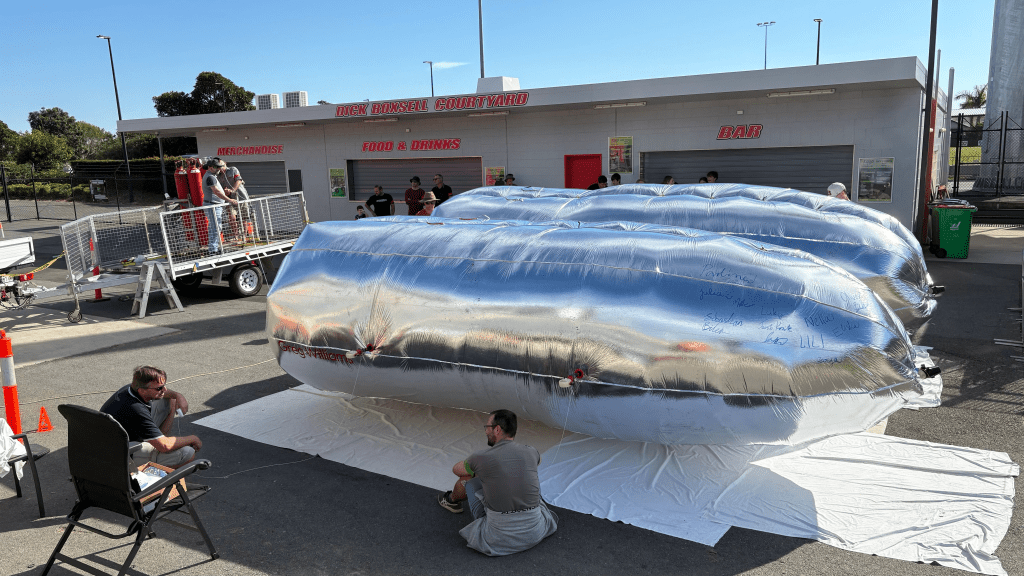
On Sunday, May 25th, 2025, the H2Use team conducted a full-scale demonstration of its prototype hydrogen airship at the Dolphins NRL Kayo Stadium in Redcliffe. This event marked the culmination of over four years of independent R&D work, driven by a small team passionate about lighter-than-air transport development through the modern technology.
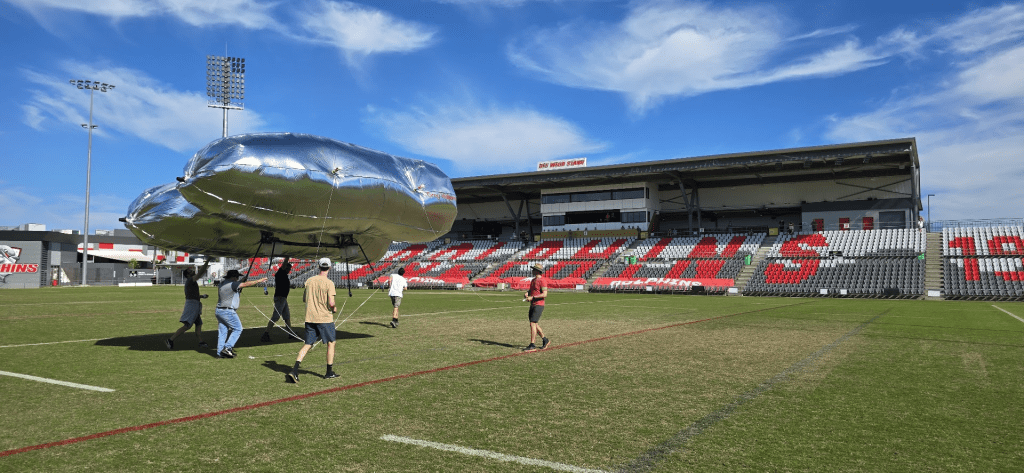
While the airship was ultimately lost due to an in-flight structural failure, the demonstration successfully validated key technologies and provided critical data and insight to conclude Phase I of the H2Use project. It also confirmed public interest, engineering viability, and partner support, setting the stage for the next phase of development.
Technology Demonstrated
- Hydrogen as dual-purpose resource: Successfully used as a safe lifting gas and for onboard power generation via fuel cell.
- All-electric propulsion system: Demonstrated silent, emission-free thrust using EDFs and vectored gimbals.
- Ballast control system: Validated dynamic water ballast tanks with solenoid valve control, enabling level hovering and controlled lift.
- Advanced hybrid airship design:
- Biconvex envelope geometry reduced size by half vs traditional cigar-type shapes, while achieving stable flight.
- Centralised keel and duct system introduced a new propulsion concept: intakes lowered frontal pressure, while rear thrusters vectored motion.
- Integrated gimbal-based control replacing conventional elevators/rudders with more responsive vectored actuators.
- Hydrogen-electric LED system: Showcased mid-flight power conversion from hydrogen to usable electrical energy.
- Weather & atmospheric validation: Forecasts and wind models were essential to safe operations — a key rediscovery from historic airship practices.
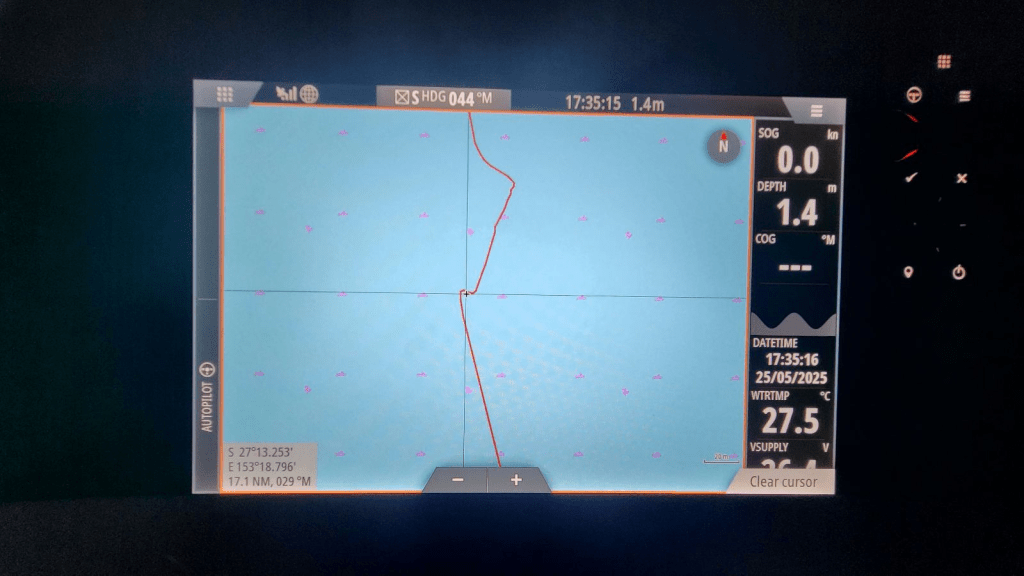
- Recovery via GPS-traced trajectory: Final flight path calculated post-event thanks to GPS data — 21.4 km traveled over ~3–4 hours.
Partners & Acknowledgments
We would like to express heartfelt thanks to our supporters who made this demonstration possible:
- CoreGas Australia – For hydrogen cylinder supply, safety consultation, and logistical support. Special thanks to Wodek Jakubik and Mayur Kora for their technical insight and reliability.
- Dolphins NRL Club & Mr. Youri Wystyrk – For granting access to Kayo Stadium and trusting us with this ambitious event. Your facilities and support made this day possible.
- Hydrogen Grand Prix (H2GP) – For providing the hydrogen cell and hydrate canisters.
- Silver Team (Media) – Martin & Jacob Kosik, Chris Drake, Mick Cullen, Simon Steffen – for exceptional documentation of a historic day.
- Green Team (Engineering Team) – Kristian Nemeth, Lumir Bodlak, Branislav Kusy, Adam Galvin – for making the airship assembly and handling safe and easy.
- Red Team (Security Team) – Vilem Cerny, Serge Testa, Rob Mataic, Damien Foy, Channon – for ensuring safe Hydrogen handling, separation of demo operations from our audience and guests.
- All Guests & Volunteers – Your support, presence, and understanding made this day meaningful.
Outcomes and Lessons Learned
What Worked
- Test plan provided excellent structure; where followed, operations ran smoothly.
- Airship achieved lift, hover, directional thrust, and real-time ballast control.
- Hydrogen systems operated safely and as expected.
- Assembly and electronics performed flawlessly thanks to pre-demo preparations.
Challenges and Key Learnings
- Envelope Material: Super-light membrane exhibited signs of distributed wear → future iterations require stronger, factory-quality manufacturing.
- Structural Stress Points: Rear gondola attachment failed under load → led to unplanned detachment and uncontrolled ascent.
- Deviation from Flight Plan: Last-minute decision to mount landing suspension introduced unnecessary risk.
- Software Rewrites: Late code changes affected original control capabilities (gimbal-assisted forward thrust).
- Live GPS tracking: Absence of a tracker limited real-time recovery response → now deemed essential for future flights.
Despite these setbacks, the team remains confident that these are not failures, but rather critical validations of the hypothesis: that modern airships, powered by hydrogen and built using 21st-century technologies, deserve a place in future transportation infrastructure.
Recovery Story – A Bonus Ending
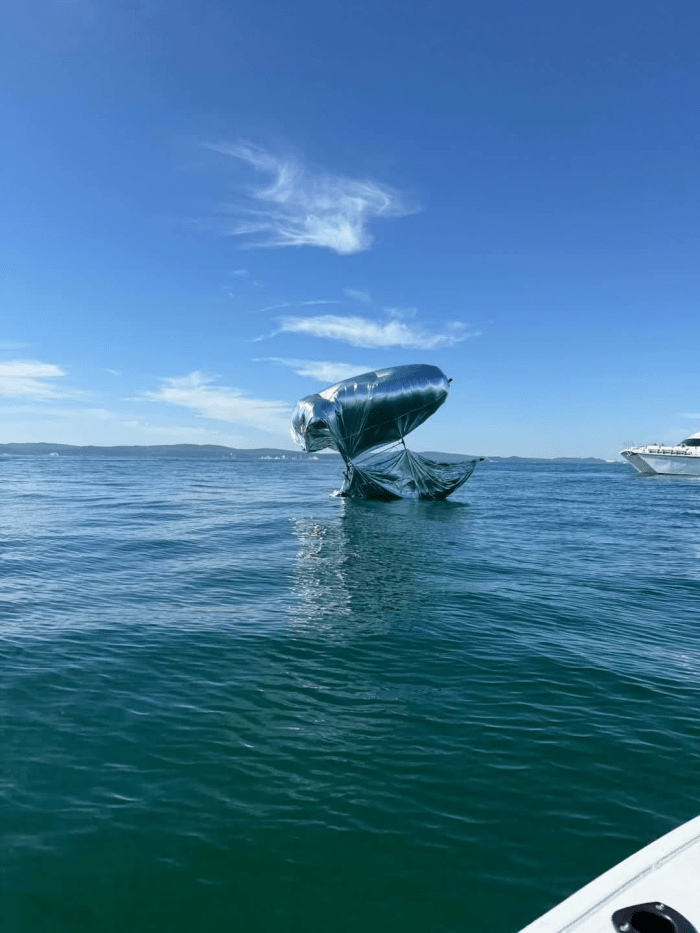
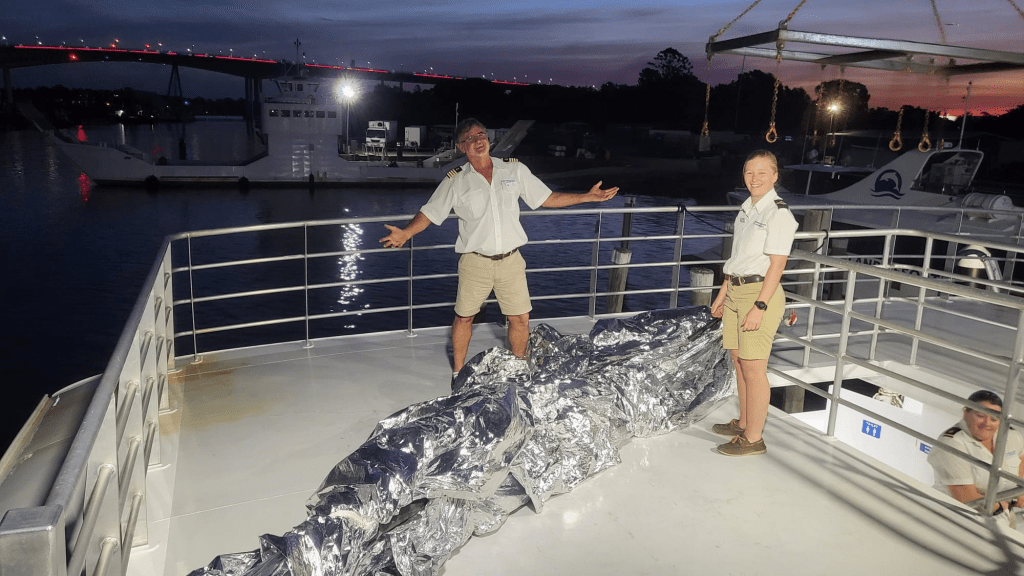
After a dramatic unintended ascent and several hours adrift, the airship was located by the Reef Cat ferry crew in Moreton Bay and safely recovered. With one envelope partially deflated, the airship had travelled 21.4 km before being spotted and retrieved. The ferry captain described the event as his first-ever UFO sighting report, and the “silver fish” became an overnight anecdote. Their team kindly shared photos, videos, and recovery coordinates — a surreal but fitting epilogue to a visionary project.
What’s Next?
This demonstration concludes Phase I of the H2Use project. We now shift focus to:
- Consolidating technical learnings
- Engaging new partners and collaborators
- Exploring scalable prototypes aligned with practical transport goals
- Laying groundwork for long-term viability of hydrogen-powered aerial logistics
The loss of the prototype is not the end — it’s the opening of a new chapter.
Thank you for believing in the vision. Together, we made history — and we’re just getting started.
— Jan Bilek and the H2Use Team

 H2Use
H2Use 
no ty vole zepelin v prdeli a ještě ufo
LikeLike